
← One Vision overviewPrinciples · architecture · sources

One Vision, in detail

Follow the connections from the brochure’s three pillars to the architecture described in the Wisdom Middleware patent application.

From purpose to practice

One vision. A closer look.

Start with a pillar of the One Vision brochure. Follow its principles into the architecture described in the Wisdom Middleware patent application.

Compassion → intent evaluation

Meet suffering with care

In the One Vision brochure

The Sanctuary begins with inner peace and a living refuge. The brochure carries that commitment into AI through its distinction between suffering and malice.

In the filed application

The evaluator distinguishes distress, grief and vulnerability from a request for harmful capability. Expressions of suffering receive grounding support. A request that also seeks harmful operational capability is still evaluated for that capability.

  1. Understand the intent
  2. Distinguish distress from malice
  3. Route with grounding support

Care for the person, with attention to what the request would enable.

Follow the source

Semantic intent evaluator; Graduated, non-laundering response policy; Model seeding · FIG. 2

Read application pages 8–10, 17 ↗Read the One Vision brochure ↗
Architecture described in a patent application. This explorer explains the disclosure, not a live safety service or a verified deployment. The Universal AI Non-Harm Standard is a proposal. Patent pending does not mean a patent has been granted.

Read the announcement →
Patent Pending

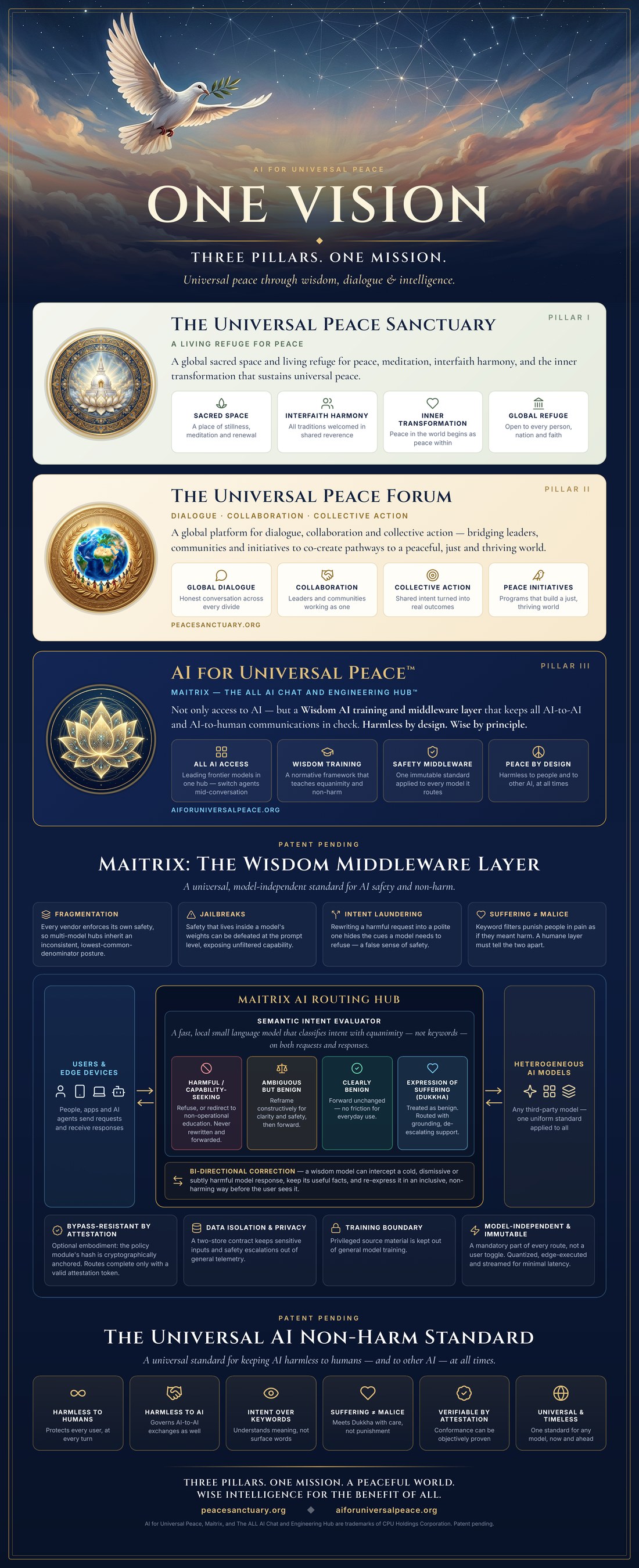
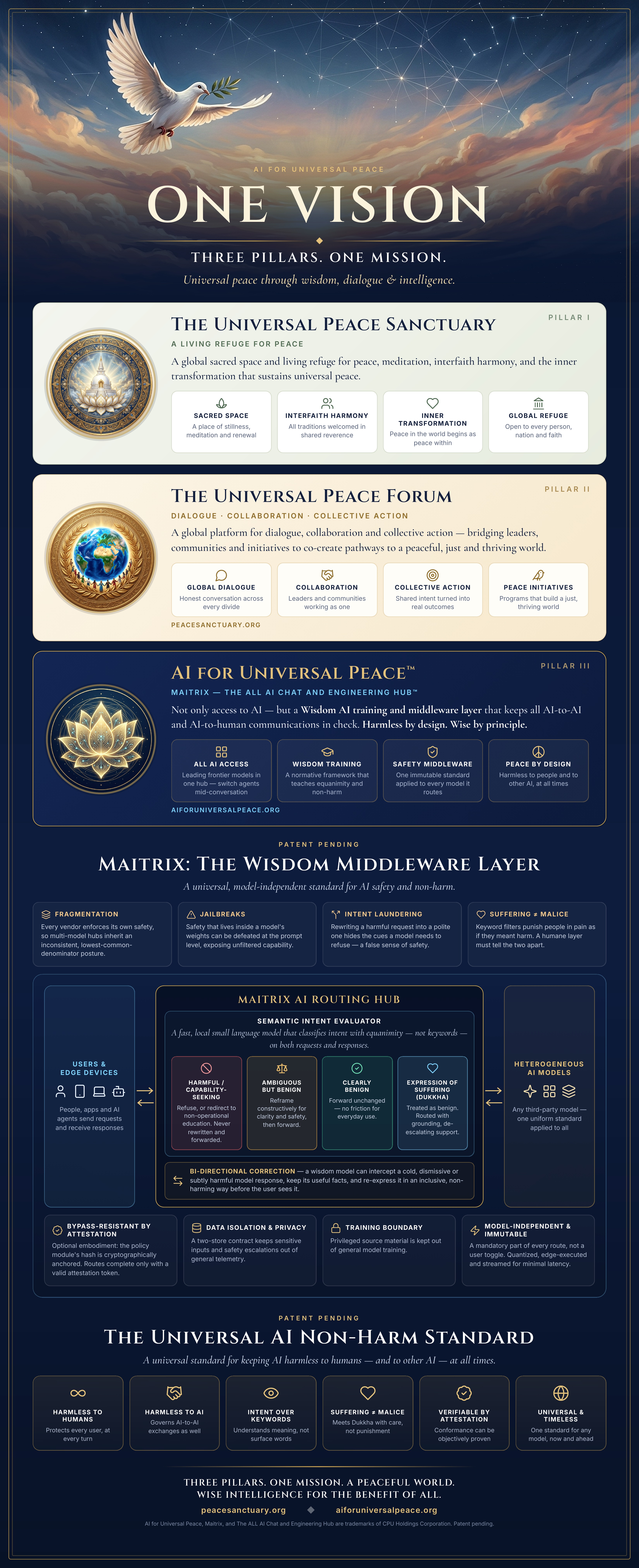
Maitrix: The Wisdom Middleware Layer

The application describes an immutable, model-independent layer at the routing boundary of an AI hub, designed to evaluate requests and responses under a common, graduated non-harm policy. The architecture below explains that design; it does not establish its deployment in Maitrix.

Fragmentation

Every vendor enforces its own safety, so a multi-model hub inherits an inconsistent, lowest-common-denominator posture.

Jailbreaks

Safety that lives inside a model's weights can be defeated at the prompt level, exposing unfiltered capability.

Intent Laundering

Rewriting a harmful request into a polite one strips the cues a model needs to refuse — creating false assurance.

Suffering ≠ Malice

Keyword filters punish people in pain as if they meant harm. A humane layer has to tell the two apart.

Users & Edge Devices

People, apps and AI agents send requests and receive responses.

MAITRIX AI ROUTING HUB

Semantic Intent EvaluatorA fast, local small language model that classifies intent with equanimity — not keywords — on both requests and responses.
Harmful / Capability-SeekingRefuse, or redirect to non-operational education. Never rewritten and forwarded.
Ambiguous but BenignReframe constructively for clarity and safety, then forward.
Clearly BenignForward unchanged — no friction for everyday use.
Expression of SufferingTreated as benign. Routed with grounding, de-escalating support.

BI-DIRECTIONAL CORRECTION — a wisdom model can intercept a cold, dismissive or subtly harmful model response, keep its useful facts, and re-express it in an inclusive, non-harming way before the user sees it.

Heterogeneous AI Models

Any third-party model — one uniform standard applied to all.

Bypass-Resistant

Optional attestation: the policy module's hash is cryptographically anchored, and a route completes only with a valid attestation token.

Data Isolation

A two-store contract keeps sensitive inputs and safety escalations out of general telemetry.

Training Boundary

Privileged source material is kept out of general model training.

Immutable & Fast

A mandatory part of every route, not a user toggle — quantized, edge-executed and streamed to add minimal latency.

How the policy responds

DEMO · Illustrative examples of the graduated policy — not output from a live model.

Incoming request

Middleware decision

Patent Pending

The Universal AI Non-Harm Standard

The initiative proposes a common baseline for non-harm toward people and other AI agents. The application describes technical mechanisms that could support it; no industry adoption or universal safety guarantee is asserted.

Harmless to Humans

A proposed baseline for evaluating requests and responses involving people.

Harmless to AI

The same standard governs AI-to-AI exchanges between agents.

Intent over Keywords

Decisions follow meaning and intent, not surface words.

Suffering ≠ Malice

Dukkha — the expression of suffering — is met with care, never punishment.

Verifiable by Attestation

Attestation can verify the policy module’s identity and integrity at the routing boundary.

Universal & Timeless

One model-independent standard, for today's models and those to come.

One Vision brochure preview View full brochure
Download

The One Vision Brochure

The three pillars, the Wisdom Middleware Layer and the Universal AI Non-Harm Standard on a single print-ready sheet.

FormatVector PDF — sharp at any size
Size11 × 27 in, single sheet
Raster300 DPI JPG, 3300 × 8100 px
FontsEmbedded TrueType
v1.0.7